


There is a specific moment, somewhere around the third product page, where a man looks at a four hundred dollar sneaker and thinks: it's a shoe. What could possibly be in there.
It is a fair question and it deserves a real answer rather than the usual noise about heritage and passion. So here is where the money actually goes, what portion of it is genuinely material cost, and more usefully, how to tell the difference between a shoe that costs a lot because it is expensive to make and a shoe that costs a lot because someone decided it should.
We sell shoes at this price. That is a conflict of interest and you should read everything below with it in mind. It is also the reason we can describe the cost structure accurately rather than guessing at it.
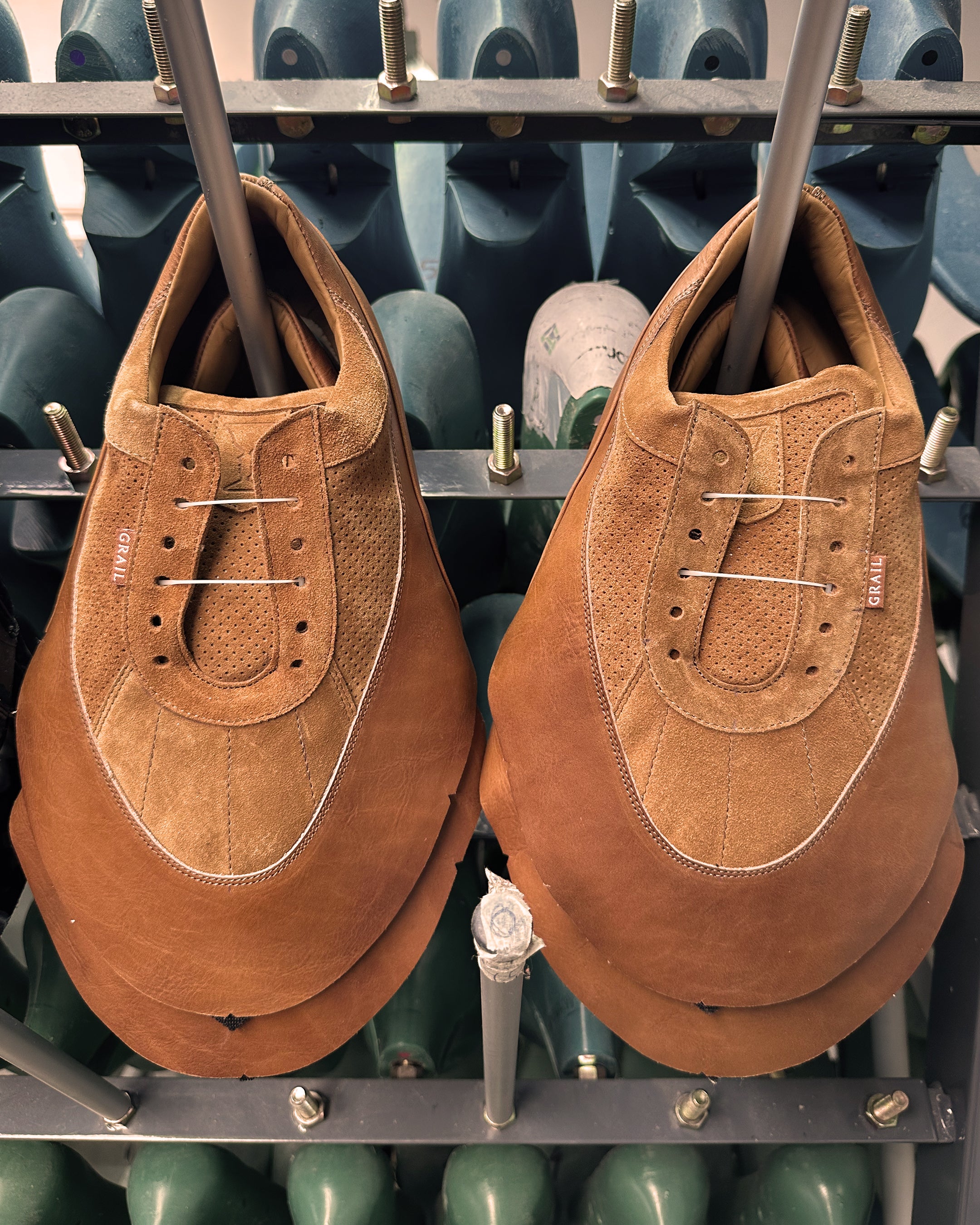
The rough shape of the thing
A leather sneaker made in Western Europe and sold direct to the customer breaks down roughly like this. These are industry-typical proportions rather than any single brand's books, and they move around considerably depending on volume.
| Component | Share of retail | What drives it |
|---|---|---|
| Leather and materials | 10 to 18% | Grade of hide, yield loss, sole and lining quality |
| Labour and factory | 10 to 15% | Country, degree of hand work, order size |
| Development and tooling | 3 to 6% | Lasts, sole moulds, sampling rounds |
| Duty, freight, warehousing | 5 to 8% | Origin, trade agreements, shipping mode |
| Returns and exchanges | 5 to 12% | Fit accuracy, free return policy |
| Marketing and acquisition | 20 to 35% | The largest single line for most direct to consumer brands |
| Gross margin | 25 to 40% | Funds staff, service, inventory risk, everything else |
Three things in that table are worth sitting with.
The first is that materials are a smaller share than most people assume. Doubling your leather cost does not double the price of the shoe. It moves retail by perhaps forty dollars. This is why the gap between a mediocre leather and an excellent one is narrower, in retail terms, than it feels, and why a brand that skimps on hide is saving very little while giving up most of what makes the shoe good. Cheapening the leather is the worst trade available in footwear and it happens constantly.
The second is that customer acquisition is usually the biggest number on the page. That is an uncomfortable thing for a brand to admit. It is also the honest reason a well-made sneaker sold through a slick funnel can cost the same as a well-made sneaker sold through a department store. The money simply moves from one middleman to another. The old model paid a retailer a keystone markup. The new model pays a platform for attention. Neither is free.
The third is returns. On a free-returns model with a fit-sensitive product, returns can quietly consume more of the retail price than the labour does. Every returned pair carries outbound shipping, inbound shipping, inspection, repackaging and a risk of markdown. This is why a brand's sizing accuracy is an economic question and not just a service one, and why the ones that invest in it can afford better materials.
Where quality actually lives
The leather
Most of the perceived difference between a $120 sneaker and a $400 one is here, and the vocabulary is deliberately confusing. Four terms matter.
- Full-grain is the outermost layer of the hide with its natural surface intact. Nothing has been sanded away. It carries the animal's real grain, including small irregularities, and it develops patina because the surface is genuine. It is also the strongest part of the hide, because the fibre density is highest near the surface.
- Top-grain has had the surface lightly sanded to remove blemishes, then refinished. Cleaner, more uniform, slightly less durable, and it patinas less because part of what would have aged has been removed.
- Corrected-grain has been sanded aggressively and given an embossed artificial grain and a heavy pigment coat. It is the surface on most white sneakers. It is uniform, cheap, easy to work with, and it does not age. It simply wears through, and when it does there is nothing underneath but sanded hide.
- Genuine leather, which despite sounding like a guarantee is the lowest usable grade in the trade: the split layers below the grain, bonded and finished. If a product page says only "genuine leather," that is the most flattering thing that could be said about it.
Nappa, which appears on our Black Coffee, is a full-grain leather tanned to stay unusually soft and pliable. It costs more per square foot and it is harder to cut cleanly, because a soft hide moves under the blade and the cutter has to compensate.
Tanning, which is invisible and expensive
Two hides of identical grade can behave completely differently depending on how they were tanned.
Chrome tanning takes roughly a day, produces soft and supple leather, and accounts for the large majority of the world's output. It is the standard for footwear uppers.
Vegetable tanning takes weeks, using tannins from bark and plant matter. It produces a firmer leather that develops much richer patina and ages more dramatically. It costs considerably more, largely because of the time the hides spend occupying a tannery.
Most quality sneakers use chrome-tanned uppers with vegetable-tanned linings or footbeds, which is a sensible compromise: softness where you touch it, structure where it matters.
Yield, the cost nobody mentions
A hide is not a rectangle. It has a spine, a belly, brand marks, insect bites, barbed wire scars and stretch variation across its area. The fibres run tighter along the back and looser at the belly, which means the same hide contains leather of very different quality.
On a premium shoe the cutter can only use the tight, even sections and has to reject a large share of the hide. On a cheap shoe, almost all of it gets used, belly included. Same hide, very different cost per pair, and it is invisible on the finished product until eighteen months in, when the belly leather on the cheaper pair starts to stretch out of shape and the toe box collapses.
This is the single clearest example of a quality difference you cannot see at purchase and cannot miss two years later.
The parts nobody photographs
Beyond the upper, several components separate a good shoe from a cheap one and none of them appear in marketing.
- Lining. A full leather lining absorbs moisture and moulds to the foot. A synthetic lining traps it. This is most of why some shoes are comfortable in hot weather and some are not.
- Insole and footbed. Cheap foam compresses permanently within months. Better footbeds use layered materials or leather-topped foam that recovers overnight.
- Counter and toe puff. The stiffeners that hold the heel cup and toe box in shape. Cheap versions are cardboard-like and break down. Good ones are thermoplastic or leather board and hold shape for the life of the shoe.
- Eyelets and hardware. Metal eyelets that are set properly do not tear out. Punched holes in unreinforced leather eventually do.
- Thread and stitch density. More stitches per inch takes longer and holds better. Count them on the shoe you are wearing now and compare.
The country
Portugal is a specific choice, not a generic European one. The country's footwear industry sits in two clusters that do genuinely different things. Felgueiras is the volume centre, producing more mass-market footwear at lower cost but with higher minimum orders, while São João da Madeira is known for super-premium handmade production. São João da Madeira is nicknamed the country's footwear capital and holds around 87 specialist companies focused on premium handmade work, supported by the Centro Tecnológico do Calçado, the national footwear technology centre.
Practically, hourly labour in a Portuguese factory runs several times what it costs in the large Asian footwear economies. You are also buying EU labour law, environmental regulation on the tanning and finishing side, and a two week rather than two month shipping lane. Some of that is ethics and some of it is just supply chain sanity, and both show up in the price.
The shorter lane has a second-order effect worth understanding. A brand that can reorder in weeks rather than months holds less inventory, guesses less about demand, and marks down less stock at the end of a season. Those savings are real and they partly offset the higher unit cost, which is a large part of why European production has become viable again for smaller brands.
What you are not automatically buying is quality. "Made in Portugal" covers both clusters. It covers factories doing eighty percent hand work and factories doing almost none. The country of origin is a necessary signal, not a sufficient one, and any brand leaning on it without naming what the factory actually does is telling you very little.

The last
The last is the foot-shaped form the shoe is built around, and it is the most expensive invisible thing in footwear.
Developing a proprietary last means months of sampling, wear testing, and grading across every size, because a last does not simply scale. A size 13 is not a size 8 multiplied. The proportions of the foot change as it gets longer, the arch position shifts, the ball width does not grow linearly, and each size has to be adjusted by hand. Getting a full size run right is a genuine engineering exercise, and it is why brands that have done it tend to talk about it.
Most brands do not do this. They buy a stock last from the factory, which is why so many sneakers in the same price band fit identically. There is nothing dishonest about it, but it means the fit is the factory's opinion rather than the brand's.
The last is also the single largest factor in whether a shoe is comfortable, which makes it the best value in the entire build and the hardest thing to photograph. If you want the practical consequences of this for buying, we covered it in our sizing and fit guide.
The construction
Sneakers are almost always cemented, meaning the upper is glued to the sole rather than stitched as it would be in a Goodyear-welted dress shoe. This is not a shortcut. It is the only sensible way to build a flexible athletic silhouette, and stitching a runner sole would make it stiff and heavy.
But cementing varies enormously in quality. Surface preparation, adhesive grade, press pressure and curing time all determine whether the sole separates in year two or year eight. A factory that rushes curing to hit a delivery date produces a shoe that looks identical and fails years earlier.
You cannot see any of this. The only proxies available to a buyer are the brand's warranty terms and what customers say after a year of wear, which is why long-term reviews are worth more than launch week ones.
Why price bands exist
Rough guide to what the money buys as you move up. Prices are US retail for men's leather sneakers.
| Band | What you typically get | Where it fails |
|---|---|---|
| Under $100 | Synthetic or corrected-grain upper, foam footbed, stock last, Asian volume production | Creasing and finish wear within a season |
| $100 to $200 | Better corrected-grain or entry top-grain, some leather lining | Ages rather than patinas. Footbed compresses |
| $200 to $350 | Top-grain or full-grain upper, leather lining, often European production | Usually a stock last. Fit is generic |
| $350 to $500 | Full-grain or nappa, full leather lining, proprietary last, premium European factory | Diminishing returns start here |
| Above $500 | Exotic leathers, hand finishing, brand premium | Increasingly you are paying for the name |
The useful observation is that the biggest jump in actual quality happens between the second and fourth bands, and that above roughly five hundred dollars the curve flattens hard. Paying more does not stop working, but it stops working efficiently.
Cost per wear, done properly
The standard argument for expensive shoes is cost per wear, and it is usually done badly, because people compare purchase prices and ignore replacement cycles.
Take a man who wears one pair three days a week, roughly 150 wears a year.
- A $120 sneaker in that rotation typically looks tired at twelve to eighteen months. Call it 200 wears. That is 60 cents per wear.
- A $400 sneaker in the same rotation, maintained, commonly runs four to five years. Call it 650 wears. That is 62 cents per wear.
They are almost identical, which is the honest answer nobody gives. The expensive shoe does not save you money. What it buys is that during those years the shoe looks presentable rather than merely functional, which has value in rooms where that matters and no value at all in rooms where it does not.
The maths shifts decisively in favour of the good pair only under two conditions: high wear frequency, and actual maintenance. A $400 shoe worn hard and never conditioned will not last four years, and then the cheap shoe wins outright.
How to tell if a price is earned
Five questions. A brand charging a premium honestly can answer all of them without straining.
- What grade is the leather, precisely? "Full-grain Italian calf" is an answer. "Premium leather" is not.
- Where is it made, and what does that factory specialise in? A country is not an answer. A region and a description of the work is.
- Is the last proprietary? If they developed it, they will say so.
- What is the sole and can it be replaced? Some cannot. That is fine, but you should know before you spend.
- What happens at eighteen months? Ask the brand directly, then go read reviews written a year after purchase.
If a brand deflects on all five and talks instead about its founding story, you are paying for the story.
Things that are pure markup
To be even-handed, some of what you pay for at every price level buys you nothing.
- Elaborate packaging. A heavy box with magnetic closures adds real cost per unit and no value after the first ten minutes.
- Celebrity association. Sometimes it correlates with quality. Usually it correlates with the marketing line in the table above.
- Limited editions of an unchanged shoe. A colourway is not a product improvement.
- Vague sustainability language. Real environmental work carries certifications and specifics. Adjectives cost nothing to print.
The uncomfortable part
Here is the thing we should say plainly.
A $399 sneaker is not three times better than a $130 one. Diminishing returns are real and they set in hard. What you get for the extra money is a shoe that ages instead of degrading, that fits a foot rather than an average, and that stays presentable long enough to be worn in situations where the cheaper pair would embarrass you.
Whether that is worth it depends entirely on how often you wear them. A man who wears one pair four days a week for three years is making a completely different calculation than a man rotating six pairs. If you are the second man, buy the cheaper shoe with a clear conscience. If you are the first, the maths tends to favour the good pair.
And if you buy the good pair, condition it. An unmaintained expensive shoe is simply an expensive shoe.
The Showman is built in Portugal on Italian leather. If you want to see how it holds up in the hands of people who are not us, the reviews are here. You may also want to read our guide to wearing sneakers with tailoring or how to make leather last.