


Business casual is the worst-named dress code in existence. It tells you nothing. It has meant a different thing in every office you have worked in, and the shoe is where the ambiguity concentrates, because the shoe is the part nobody writes down in the handbook.
Here is what actually passes, sorted by how much risk you are taking.
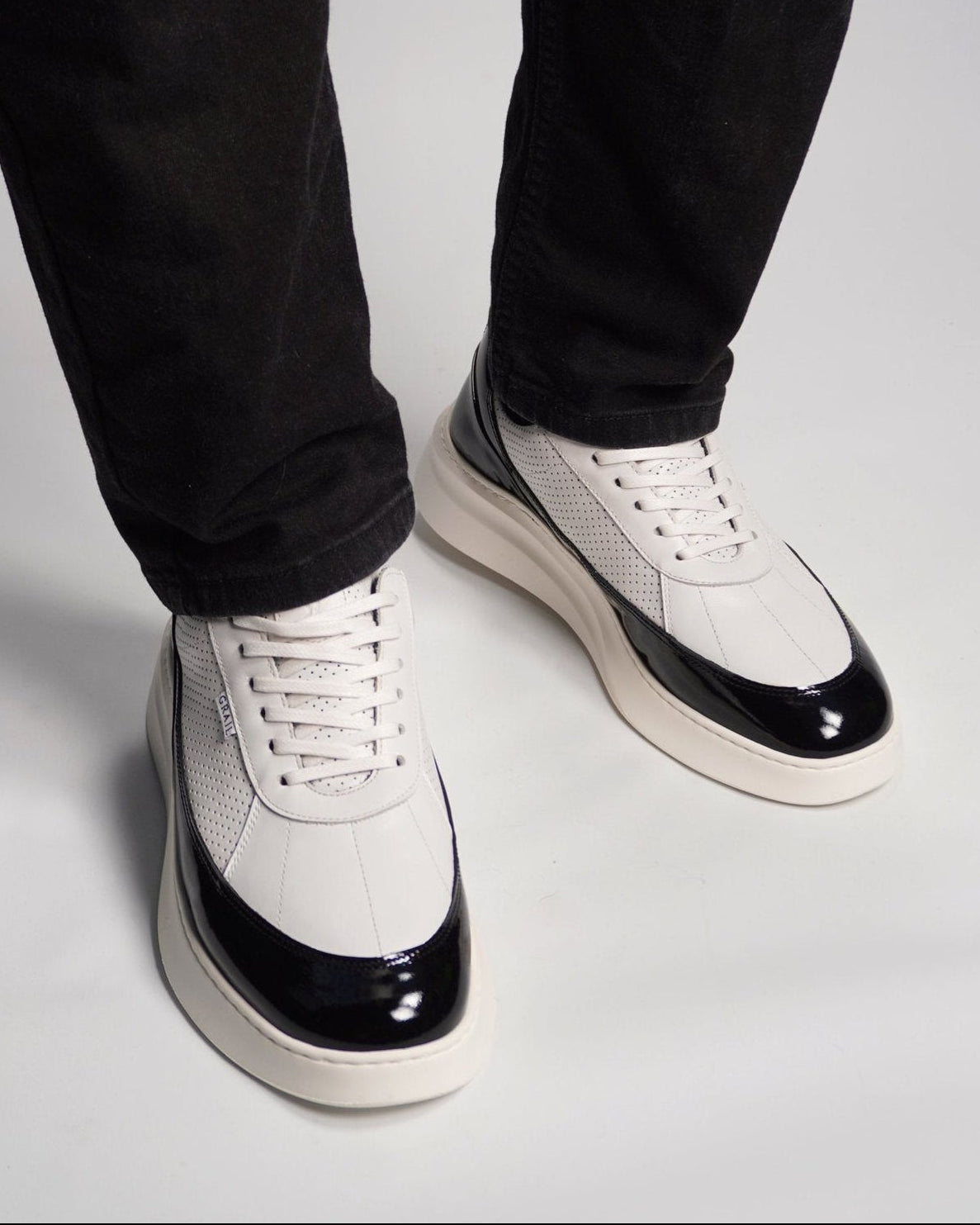
Why the term is incoherent
It helps to know where this came from, because the confusion is historical rather than personal. You are not failing to understand a clear rule. There was never a clear rule.
Business casual entered American offices through casual Friday in the 1980s and 1990s, and it was invented to solve a problem that had nothing to do with clothing. Companies wanted a low-cost perk. Letting people dress down one day a week cost nothing and felt generous. Nobody defined it because nobody expected it to matter.
Then it spread from Friday to the whole week, and the undefined thing became the default thing. By the time it mattered, there was no authority to appeal to. Every office wrote its own version, most of them by listing what was banned rather than what was expected, which is why handbooks say things like "no shorts, no flip-flops" and stop.
Then remote work arrived and dismantled what little consensus remained. Offices that reopened found people had recalibrated permanently downward and there was no persuading them back.
The practical consequence: business casual is not a code you can look up. It is a local dialect, and the only reliable method is to read the specific room you are in. Most of this article is about how to do that.
What business casual is really measuring
Every dress code is a proxy for one question: does this person understand where they are? Formality is just the language that question is asked in. Business casual removed most of the explicit rules but kept the question, which is why it feels harder than a strict code rather than easier. A strict code tells you the answer. A loose one tests whether you can work it out.
Applied to footwear, it resolves into three things people notice without meaning to:
- Material. Leather reads considered. Mesh, canvas and synthetics read recreational.
- Silhouette. Low and tapered reads dressed. Tall and blunt reads athletic.
- Condition. This one outweighs the other two combined. A clean modest shoe beats an expensive scuffed one every time, in every room, without exception.
Almost every business casual footwear mistake is a failure on one of those three, not a failure to know some obscure rule. If you internalise nothing else, internalise that condition is the dominant variable, because it is also the one entirely within your control.
The tiers
| Shoe | Risk level | Where it lands |
|---|---|---|
| Leather derby or loafer | None | Passes anywhere business casual is written down |
| Leather dress sneaker, dark colour | Very low | Passes in almost every modern office. Reads as a choice |
| Chelsea or chukka boot | Very low | Strong in cooler months, slightly formal for summer |
| Leather dress sneaker, white or stone | Low | Fine if immaculate. Fails badly if not |
| Suede sneaker | Low to moderate | Reads softer and more casual than the same shoe in leather |
| Canvas or court sneaker | Moderate | Depends heavily on the office |
| Performance runner | High | Reads as commuting footwear you forgot to change out of |
| Anything with prominent branding | High | The logo does the talking, and it says something casual |
| Sandals of any kind | Very high | Almost universally out, regardless of climate |
By industry
Sector shifts the whole table up or down by a tier or two. This is a generalisation and your specific employer overrides it, but as a starting position:
| Sector | Where the line sits |
|---|---|
| Software and product | Almost anything leather passes. A dress sneaker is often the formal option |
| Creative, agency, media | Sneakers expected. A derby can read stiff |
| Consulting | Client-dependent by the day. Keep a leather option in the bag |
| Finance, front office | Leather shoes. Dress sneakers only in genuinely modern firms |
| Law | The most conservative of the professional sectors. Assume no unless told |
| Sales | Match the customer, not the office |
| Healthcare administration | Conservative, and closed leather is often a safety requirement |
| Academia | Wide latitude, minimal enforcement |
Reading your specific office
Ignore the handbook. Look at three people instead.
The most senior person who is not the founder. Founders are exempt from dress codes and are a useless reference point. Somebody who built the company can wear whatever they want and frequently does, precisely to demonstrate that they can. The person one level below them is wearing what the organisation actually rewards, because they are still being evaluated.
The person who deals with clients most. They have the most direct feedback loop with outside expectations and they calibrate faster than anyone. If they have quietly moved to leather sneakers, that is a strong signal. If they have quietly moved back to derbies, that is a stronger one.
The person who was hired most recently at your level. They dressed for the interview and then adjusted over their first months. Whatever they settled on is a fresh read on the room, uncontaminated by years of habit.
If all three wear leather shoes, wear leather shoes. If two of the three wear leather sneakers, you have your answer and you did not need a guide to find it.
One caution. Do not calibrate to the most casually dressed person in the building. There is one in every office, they are usually tolerated rather than emulated, and copying them means adopting somebody else's accumulated goodwill without having accumulated any.
The boardroom question specifically
There is a difference between what passes at your desk and what passes when you are presenting. In a room where you are the one speaking, everything about you is being read more closely, and the shoe gets a share of that attention it would not otherwise receive.
Rules for the room where you are the one talking:
- Go one notch more formal than your normal day. If you usually wear a white sneaker, wear the dark one. If you usually wear a dark sneaker and the stakes are high, wear the derby.
- Leather only. This is not the day for suede or canvas, both of which read soft under overhead lighting.
- Nothing that squeaks. Rubber on polished concrete is loud and you will be walking to the front of the room in silence. Test this before the meeting, not during it.
- Check the sole edge. People sitting down are eye level with your feet, and a grubby midsole is far more visible from a chair than from standing. This is the single most common oversight in the entire subject.
- Consider what you will be doing. If you are standing at a whiteboard for an hour, you will be seen from every angle. If you are seated at a table, only the front of the shoe is visible.

Trousers change the answer
The same shoe reads differently depending on what it comes out of, and this is where most men underestimate the interaction.
Wool trousers. The most demanding. Wool has drape and sheen and it makes a cheap sneaker look cheaper by contrast. Only a real leather shoe holds up. If you wear wool trousers regularly, this alone justifies owning one good pair.
Chinos. The most forgiving, and the natural home of the business casual sneaker. Cotton and leather sit at a similar level of formality and neither is trying to outrank the other. Almost anything in the top five tiers works here.
Dark denim. Works in offices that allow denim at all. The rule is that the denim has to be genuinely dark and genuinely unfaded. Once jeans start to fade at the thigh and knee, the whole outfit drops a level and the shoe cannot rescue it.
Technical or five-pocket synthetics. Increasingly common and slightly treacherous. They photograph as smart and read as athletic in person, so they need the shoe to pull upward, not downward. A dark leather sneaker is the right answer. A white one compounds the problem.
Corduroy and heavier cottons. Textured and inherently casual, which makes them very compatible with suede and with warmer leather colours. Cognac over corduroy is one of the easiest wins available in autumn.
Hem length matters more than most men think. A trouser that stops just above the top of the shoe, showing a small clean gap, makes almost any shoe look more deliberate. A trouser that piles up on the shoe makes almost any shoe look accidental. This is a tailoring fix that costs very little and changes everything.
The rest of the outfit
The shoe is never judged alone, and you can buy yourself latitude at the bottom by adding formality at the top.
Shirt. An oxford cloth button-down is the workhorse and reads slightly casual. A poplin dress shirt reads formal and will carry a sneaker further than you expect. A polo drops the whole outfit a level.
Knitwear. A fine-gauge merino crewneck or half-zip over a collared shirt is one of the most reliable business casual combinations available, and it is generous to sneakers because the softness at the top matches the softness at the bottom. Chunky knits pull casual.
Outerwear. This matters more than people think because it is what colleagues see when you arrive and leave. A wool overcoat over a sneaker is a strong, deliberate contrast. A technical shell over the same shoe turns the whole outfit into commuting gear.
Bag. A leather briefcase or a structured leather tote lifts an outfit noticeably. A backpack, particularly a technical one, drags it down. If you wear sneakers and carry a nylon backpack, the two casual signals compound.
Colour strategy
If you are choosing one or two pairs for work, the ranking is fairly settled.
- Black or black-brown. The most versatile and most formal. Works with grey, charcoal, navy and black trousers. If you own one work sneaker, this is it.
- Deep cognac or dark brown. Warmer, slightly more interesting, excellent with navy and grey. Marginally less formal than black.
- Navy. Quiet and underused. Very good with grey and tan, awkward with black.
- Grey. Genuinely neutral and easy, though it can read a little flat next to good wool.
- White or stone. Excellent in warm months, high maintenance, and entirely dependent on being clean.
The sole colour is a separate decision and arguably more important. A tonal dark sole makes a shoe read considerably more formal than the identical upper on a white sole, because a bright band at floor level pulls the eye down and announces sneaker.
Hybrid work changes the calculation
Two or three days in the office per week creates a problem nobody had before: your in-office days are now higher stakes than they used to be, because they are the only days anyone sees you.
The practical effects:
- Fewer office days means each one carries more weight. Dressing marginally better on two days is easier than dressing well on five, and the return is higher.
- In-office days now cluster around meetings, since that is usually why people come in. Assume you are more visible than you would have been on a random Tuesday in 2019.
- Your shoes get worn less, which means one good pair goes considerably further than it used to. The cost-per-wear argument for buying well has weakened, but the argument for owning fewer, better things has strengthened.
Travel days
Business travel is the strongest possible justification for a leather sneaker and worth treating as its own case. You are on your feet in airports, you need one pair that works for a flight and a meeting, and nobody has ever questioned a traveller's comfort.
Pick the darkest leather pair you own, wear the heaviest items on the plane, and clean the shoes the night before rather than the morning of. A shoe that has just been conditioned needs a few hours to settle.
Common mistakes
Buying a white pair as your only work sneaker. White is the highest-maintenance colour and the least forgiving in a formal room. It is a good second pair and a risky first one.
Treating the shoe as the whole decision. The trouser hem and the sock do at least as much work.
Ignoring the sole. Cleaning the upper and leaving a grey midsole is the most common half-finished job in footwear.
Wearing the same pair every day. Leather needs roughly a day to dry out after wear. A shoe that never gets that day creases harder and breaks down faster, which is a quality problem masquerading as a value problem.
Dressing for the office you wish you worked in. There is a version of this in both directions and both are conspicuous.
The socks paragraph nobody wants
Business casual with a sneaker is the exact situation where no-show socks fail. The gap of bare ankle between hem and shoe is fine on a weekend and reads as sloppy in an office. If you want the ankle bare, wear it with chinos on a Friday. In a room where you are being evaluated, wear a sock that reaches the calf in a colour close to the trouser.
There is a practical argument too. No-show socks let the foot sweat directly into the shoe's lining, which is the fastest way to ruin the inside of a leather sneaker and produce odour that no amount of cleaning the outside will fix.
What we would actually recommend
If you want one shoe that removes this decision permanently, it is a dark leather sneaker on a low tonal sole. Not white, not suede, not a court silhouette. Something in black, black-brown, navy or deep cognac that reads as a dress shoe at conversational distance and as a sneaker up close.
It clears every tier in the table above except the most conservative professional settings, and in those you were going to wear a derby anyway. Our Black Coffee and Navy Showman were built for precisely this slot, though the principle holds whoever you buy from.
Common questions
Are white sneakers business casual? Yes, conditionally. A white leather sneaker in genuinely clean condition passes in most modern offices. The condition clause is doing all the work in that sentence, and keeping them that way takes about thirty seconds a day.
Can I wear sneakers to an interview? Generally no, even at companies where employees wear them daily. An interview is the one occasion where you dress for the organisation's self-image rather than its actual behaviour. You can dress down after you have the job.
What about Fridays? If your office observes a casual Friday, the range widens by roughly one tier in the table. Suede and court sneakers become comfortable. Runners still do not.
Does the sole colour matter? More than the upper colour, oddly. A white or gum sole under a dark upper pulls the whole shoe casual. A dark sole under a dark upper is the most formal a sneaker gets.
Can I wear a sneaker with a suit at work? Different question with a longer answer, covered in our guide to sneakers and tailoring.
How many work sneakers do I need? One is enough if it is dark and you maintain it. Two lets you alternate days, which meaningfully extends the life of both.
Is it worth spending a lot on a work shoe? Depends on frequency. We did the arithmetic honestly in our breakdown of what goes into the price, including the case against.
Grails are built in Portugal on Italian leather, cut low and tapered for exactly this kind of room. See the range, or check the fit guide before you order.