


The question gets asked badly. People ask whether sneakers can go with a suit, as though there were a rule waiting to be discovered. There isn't. There are only outcomes. Some combinations read as deliberate. Some read as a man who was running late.
This is a guide to landing on the deliberate side. It is written for the man who has to make this call on a Tuesday morning with a client dinner on the calendar, not for the man who wants a philosophy of menswear.
The short answer
Yes. A sneaker works with a suit when three things are true at once:
- The sneaker is built on a dress silhouette in a real leather, not a court shoe or a runner.
- The suit is cut soft and modern, not structured and formal.
- The room permits it, which is the variable most men get wrong.
Miss one and you can usually still get away with it. Miss two and you look underdressed. Miss all three and you look like you lost your other shoes.
Everything below is an expansion of those three points, plus what to do when they conflict.
Why this stopped being a question
For most of the twentieth century, the shoe was the least negotiable part of a man's outfit. A suit came with a leather-soled oxford or derby and that was the end of the conversation. Footwear was governed by a code so settled that it did not need stating, and the code held because the suit itself was compulsory. You did not choose to wear one. You wore one because you were going to work.
What broke the rule was not fashion. It was the collapse of the office dress code.
The shift happened in stages. Casual Friday arrived in American offices in the 1990s and quietly established that formality could be negotiated. The tech industry then removed the suit from the top of the hierarchy entirely, which was the genuinely radical move, because it decoupled authority from tailoring. When the most powerful person in the building wears a fleece, the suit stops being a uniform and becomes a costume choice.
The last stage was remote work. Several years of people doing serious jobs in whatever they liked permanently damaged the assumption that formality and competence are related. Offices that returned to full tailoring found that nobody believed in it anymore.
The suit did not disappear through any of this. It migrated. It became something you choose rather than something you obey, and a chosen suit follows different rules than an obligatory one. A man wearing a suit today is making a statement about himself, not complying with an instruction, and a statement is allowed to have personality in it. The moment the suit became optional, so did the oxford.
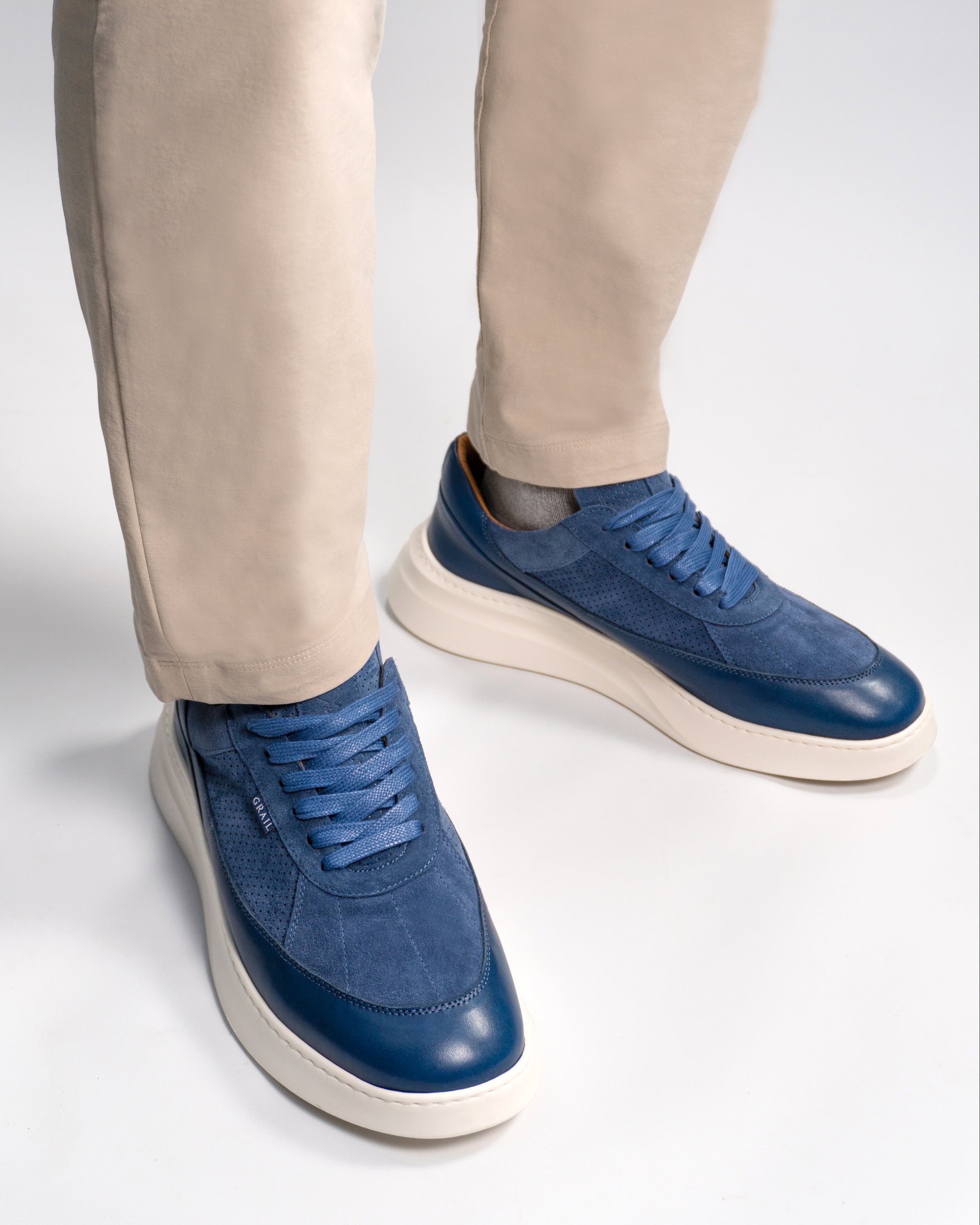
What emerged in the gap is the dress sneaker: a shoe with the proportions and materials of a formal shoe and the sole and comfort of an athletic one. It exists specifically to solve this problem. Not every sneaker is one. Most are not, and telling the difference is the whole skill.
Variable one: the sneaker
This is where most of the failures happen, and they happen for an understandable reason. Men reach for the nicest sneaker they own, which is usually a nice athletic sneaker. Nice is not the same as appropriate. A four hundred dollar running shoe is still a running shoe, and putting it under tailoring produces a worse result than a modest leather one.
Four categories, and only one of them belongs anywhere near a suit.
| Type | Upper | Sole | Works with a suit? |
|---|---|---|---|
| Dress sneaker | Full-grain or nappa leather, minimal branding, close-trimmed panels | Slim, low-profile, often a refined runner sole | Yes. This is the category built for it |
| Court or tennis sneaker | Corrected-grain leather, visible perforations, cupsole edges | Flat white cupsole, thick sidewall | Occasionally, with a very soft suit and no clients present |
| Performance runner | Engineered mesh, synthetic overlays | Foam midsole, aggressive geometry | No |
| Skate or chunky trainer | Suede or canvas, heavy stitching | Vulcanized or oversized | No |
Proportion is the first tell
Put the shoe next to a dress shoe you own and look at the toe box from the side. A dress silhouette tapers and sits low. A court sneaker sits high and blunt, and that extra height under a trouser hem is what reads as wrong even to people who cannot articulate why.
There is a mechanical reason for this. Trousers are cut and hemmed on the assumption of a certain shoe height. A dress shoe presents perhaps two centimetres of material between the floor and the top of the vamp. A chunky sneaker presents four or five. That difference changes where the trouser breaks, how much sock shows, and how long your leg appears. The shoe is not just an object at the end of the outfit. It is a structural component of the outfit's proportions.
Material is the second
A suit is made of a fabric with depth. Worsted wool has a subtle sheen and a visible weave, and it wants a shoe with comparable material honesty. Corrected-grain leather, the uniform plasticky surface used on most white sneakers, has no depth at all. Next to good cloth it looks flat, and the eye registers the mismatch instantly even if the brain does not name it.
Nappa and full-grain leather do not have this problem, which is the entire reason a leather-forward sneaker costs what it costs. The surface catches light unevenly, the way wool does, and the two materials sit at the same level of visual richness.
The sole colour, which nobody considers
This matters more than the colour of the upper and almost nobody thinks about it. A white or gum sole under any upper pulls the entire shoe casual, because a bright band at floor level draws the eye downward and announces sneaker. A dark sole under a dark upper is the most formal a sneaker can get, because the shoe reads as a single continuous mass, which is exactly how a dress shoe reads.
If you own one pair for tailoring, a tonal sole is worth prioritising over almost any other feature.
Branding
A logo on the side panel is a statement about the shoe. Tailoring wants the shoe to be a statement about you. Anything with a visible swoosh, stripe, or wordmark is doing a different job than the suit is, and the two will argue.
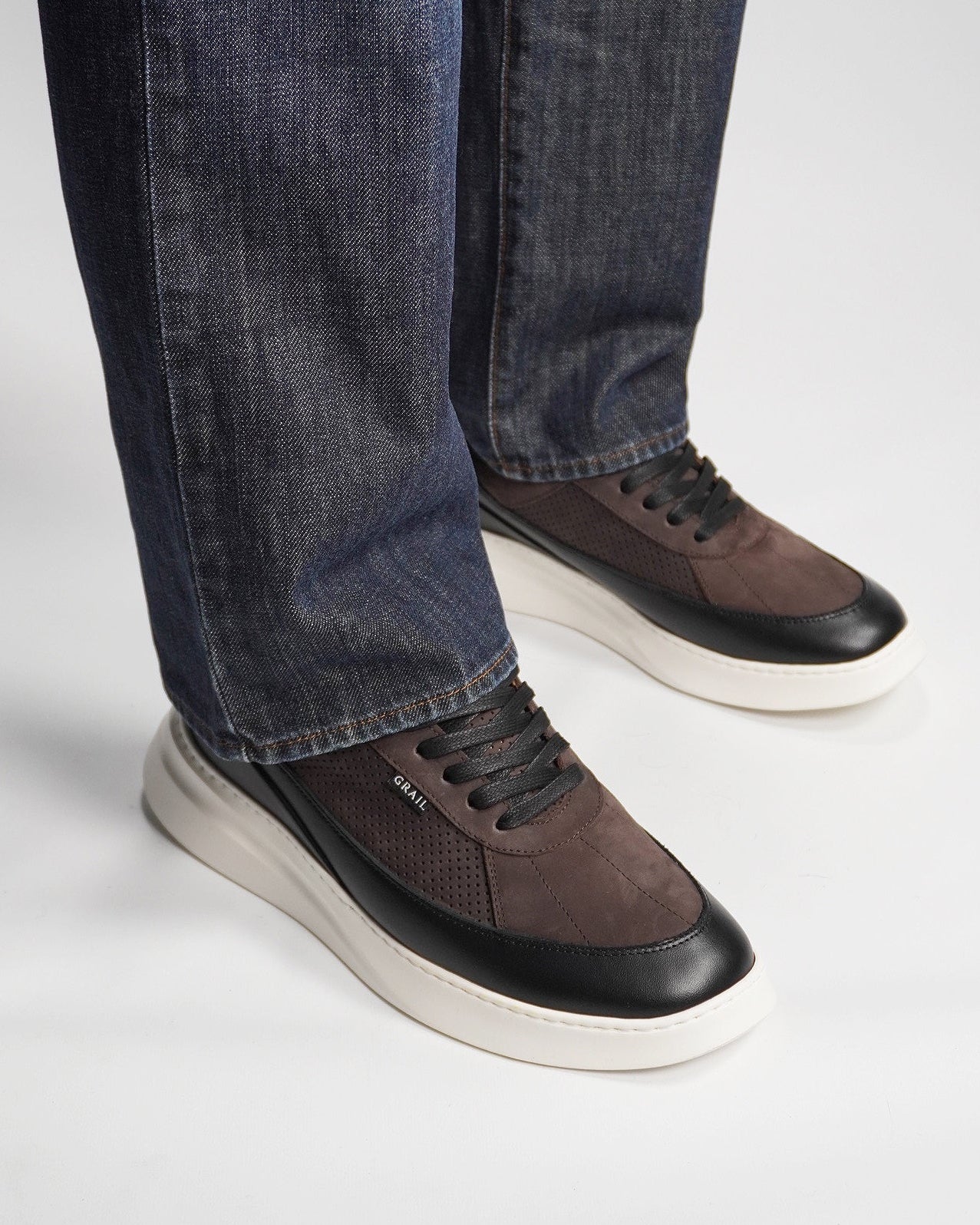
Our own Showman was designed against exactly this brief, Italian leather on a runner sole cut to a dress proportion, which is a bias we may as well state out loud rather than pretend we don't have.
Variable two: the suit
A sneaker does not fail against a suit. It fails against a formal suit. The distinction is structural, and it is worth understanding rather than memorising, because it lets you judge a suit you have never seen before.
Structure
Suits that take a sneaker well: unstructured or half-lined shoulders, patch pockets, minimal canvas, soft lapel roll. These are jackets that follow the body rather than imposing a shape on it, and a soft shoe belongs under a soft jacket.
Suits that reject a sneaker: heavily padded shoulders, ticket pockets, hard canvassing, anything double-breasted. Structure is a formality signal. The more architecture in the shoulder, the more the outfit is announcing ceremony, and ceremony demands a leather sole.
Fabric
Texture is permission. A fabric with visible weave and irregularity is casual by nature and pairs comfortably with a sneaker. A fabric with a smooth, hard, slightly reflective finish is formal by nature and does not.
- Excellent: hopsack, fresco, cotton, linen and linen blends, flannel, tweed, texture-forward wools
- Workable: mid-weight worsted in a matte finish, birdseye, nailhead
- Difficult: high-twist smooth worsted, sharkskin, anything with a sheen
- No: mohair blends, velvet, chalk stripe, dinner suits of any kind
Colour
Mid-range colours are permissive: navy, charcoal, olive, brown, mid-grey, tan. Black is not, and this trips people up because black feels neutral. It is not neutral in tailoring. Black is the most formal colour a suit comes in, it is associated almost exclusively with evening wear, weddings and funerals, and it resists casual footwear more stubbornly than any other shade.
The hem, which decides more than anything else
The trouser hem is the single most underrated part of this. A full break, meaning the trouser pooling on the shoe, is designed to sit on a low-profile leather sole. Put that hem on a sneaker and the fabric bunches around a shoe that is taller than it expects, and the whole thing collapses into a puddle at the ankle.
You want a clean quarter break or none at all. The trouser should touch the top of the shoe and stop, or stop just above it and show a small clean gap.
A tailor will do this for very little money and it is the highest-leverage change you can make to the entire outfit. If you take one thing from this article and ignore everything else, take this one. A cheap suit with a correct hem over a good sneaker beats an expensive suit with a full break every time.
Variable three: the room
This is the one that actually decides it, and no amount of shoe quality overrides it.
| Setting | Verdict | Why |
|---|---|---|
| Startup or agency office | Yes | The suit is already the formal end of the range |
| Client pitch, creative industry | Yes | Signals confidence and current taste |
| Client pitch, finance or law | Risky | Depends entirely on the client, not on you |
| Conference, speaking | Yes | You are on your feet for hours and the room expects personality |
| Business travel | Yes | The most defensible use case there is |
| Dinner, restaurant | Yes | Evening softens most codes rather than hardening them |
| Wedding, as a guest | Depends | Daytime and outdoor, usually fine. Black tie, never |
| Wedding, in the party | No | You are part of a coordinated group, not an individual |
| Funeral | No | Not the day to make a point |
| Court appearance, formal interview | No | Institutions with dress codes are not persuadable |
The underlying principle: a sneaker with a suit works when it looks like a choice and fails when it looks like a compromise.
In a room where everyone else is in leather soles, your sneaker reads as a compromise regardless of what it cost. In a room where half the people are in trainers and jeans, a suit with a sharp leather sneaker makes you the best dressed man there. The shoe has not changed. The reading has.
This is also why the answer differs by geography and industry in ways no general guide can settle. Milan and Los Angeles will judge the same outfit differently. So will a London law firm and a Berlin studio. When you do not know the room, the safe move is to dress for the more formal reading, because being slightly overdressed costs you nothing and being underdressed costs you the first two minutes of every conversation.
The separates question
Most of what is written about sneakers and suits actually applies to sneakers and full matching suits. Separates are a different and much easier problem.
A navy blazer with grey trousers is significantly less formal than a navy suit, even though the individual pieces look similar. The mismatch itself signals that you are not in uniform, which lowers the formality of the whole outfit by roughly one level and widens what the shoe can be.
Practically, this means that if you are nervous about the full suit version, start with separates. A soft blazer, contrasting trousers and a dark leather sneaker is close to unimpeachable in any modern office, and it lets you get comfortable with the proportions before committing to the matching version.
The same logic runs the other way. If you have a suit that is too formal for a sneaker, breaking it up solves the problem. Wear the jacket with different trousers and the sneaker becomes viable.
Season
Nobody mentions this and it changes the answer noticeably.
Spring and summer are the natural season for this look. Lighter fabrics are inherently more casual, the palette opens up, and white or stone sneakers become genuinely correct rather than merely permitted. Linen and cotton suiting practically asks for a sneaker.
Autumn and winter are harder. Heavier fabrics read more formal, dark palettes tighten the range, and a sneaker in a room full of overcoats and boots can look thin. This is the season where the dark, tonal-soled leather sneaker earns its money, and where suede becomes an asset rather than a liability because it reads warm.
Weather is also a practical constraint. Most dress sneakers are not built for rain or salt, and a shoe destroyed by one bad commute was not saving you anything.
Colour, in order of safety
If you are doing this for the first time, work down this list.
- Dark brown or cognac with navy or grey. The most forgiving pairing in menswear. Warm brown against cool wool is the same logic that makes a brown derby work with a navy suit, and it has been correct for a century.
- Black or near-black with charcoal. Reads almost like a dress shoe from three feet away, which is often the whole point.
- Navy with grey. Quiet, slightly unusual, hard to get wrong.
- Off-white or stone with navy, olive or tan. Very good in warm weather. Requires the shoe to be genuinely clean, because white is unforgiving of neglect in a way dark leather is not.
- A colour. Green, oxblood, deep red. This is a deliberate statement and should be treated as one. It works when the rest of the outfit is quiet.
Match the shoe to your belt or watch strap if you wear either. Do not match the shoe to your tie.
Five outfit formulas that work
If you want to stop thinking about this, here are five combinations that are reliably correct. Each specifies the whole outfit, because the shoe is never the only variable.
1. The default. Navy soft-shouldered suit, quarter break. White or pale blue shirt, no tie, top button open. Dark brown or cognac leather sneaker with a tonal sole. Navy socks. This works in almost every room where a sneaker is permitted at all.
2. The winter version. Charcoal flannel suit. Fine-gauge grey or burgundy knit instead of a shirt. Black or black-brown leather sneaker. Charcoal socks. The knit does most of the casual work, which lets the shoe stay dark and quiet.
3. Summer, outdoor. Tan or light grey cotton or linen suit, no break at all. White or ecru shirt. Off-white or stone sneaker. Light socks or, at an outdoor daytime event only, no-shows. Wedding-guest appropriate in most warm climates.
4. Travel. Mid-grey unstructured travel suit in a wrinkle-resistant weave. Dark polo or fine knit. Navy or black sneaker. The single most defensible use case for this whole look, because comfort has an obvious justification and nobody questions it.
5. The statement. Olive or brown suit. White shirt. Cognac or oxblood sneaker. This is for a creative room where being memorable is an asset. It will not work in finance and is not meant to.
Seven ways men get this wrong
Wearing the wrong socks. No-show socks with a suit leave a gap of bare ankle above the shoe that undoes the formality of the whole outfit. Wear a proper sock in a colour close to the trouser. The sneaker is already doing the casual work. You do not need the ankle to help.
Keeping the full break. Covered above, and worth repeating because it is the most common single error and the easiest to fix.
Choosing a sneaker with visible branding. The logo talks louder than the tailoring.
Wearing a beaten pair. A dress sneaker only reads as intentional when it looks cared for. Scuffed toe boxes and grey midsoles read as your everyday shoes pressed into service. Clean leather, clean sole, fresh laces. This is the cheapest possible upgrade and the one most often skipped.
Overcompensating elsewhere. Men who feel underdressed at the shoe often add a pocket square, a tie bar and a lapel pin to compensate. The result is an outfit at war with itself. If the shoe is casual, let the rest be quiet.
Wearing a bright sole with a dark suit. A white midsole under charcoal is the single most visually jarring version of this look, because the eye goes straight to the brightest thing in the frame and it is at floor level.
Doing it in a room that has already told you not to. If you have to ask whether the room permits it, and you cannot answer, the answer is probably no.
The test
Stand in front of a mirror at full length. Look only at the last six inches: the hem, the ankle, the shoe. Ask one question. Does this look like the outfit was designed this way, or does it look like something got substituted at the last minute?
You will know. Everyone knows. The eye is very good at spotting the difference between a decision and an accident, and that is really the only thing being judged.
A second test, if the first is inconclusive. Photograph yourself from six feet away. Cameras flatten and clarify. A combination that looks fine in a mirror and wrong in a photograph is wrong.
If you get it wrong
You will, at some point, walk into a room and realise immediately that the shoe is a mistake. Two things help.
First, do not draw attention to it. Nobody notices a shoe until its owner starts apologising for it. Confidence is doing more work in this entire subject than any specific garment.
Second, adjust the rest upward. Button the jacket. Straighten posture. If you have a tie in your bag, put it on. Formality is read as a whole, and lifting the top half meaningfully offsets the bottom.
Building around one pair
If you are buying a single pair to cover this, the specification is narrow and worth writing down:
- Full-grain or nappa leather, not corrected grain
- Dark colour: black, black-brown, deep cognac or navy
- Tonal sole, not white or gum
- Low, tapered profile
- No visible branding
- Minimal panelling and clean stitching
A shoe meeting all six will carry a suit on Tuesday and dark denim on Saturday, which is the real argument for spending properly once rather than adequately three times. If you want the reasoning behind what a pair like that actually costs to make, we broke it down in why a $399 sneaker costs $399.
Questions we get
Can I wear sneakers with a black suit? Technically yes, in practice rarely. Black suits are the most formal thing most men own and they almost always appear in contexts such as weddings, funerals and formal evenings where a sneaker is out of place. If the black suit is being worn casually, a black leather dress sneaker is the only version that works.
What about white sneakers with a suit? Yes, and it is one of the strongest looks in warm weather, but only with a genuinely clean pair. White magnifies neglect. If you are going to do this, read how to keep them clean first.
Do I need a different sneaker for this than for the weekend? Ideally no. That is the argument for buying one very good leather pair rather than three mediocre ones. If yours cannot do both, it is not a dress sneaker.
Can I wear a tie with sneakers? Yes, though it narrows the range. A tie raises formality at the top while the shoe lowers it at the bottom, and the outfit has to be confident enough to carry the tension. Knitted and textured ties work better here than smooth silk.
What about suede instead of leather? Suede reads one notch more casual than the same shoe in smooth leather, which makes it excellent with separates and slightly risky with a formal suit. In autumn it is often the better choice.
Should the sneaker match my belt? If you wear a belt, yes, approximately. Exact matching is unnecessary and slightly try-hard. Same family of colour is enough.
Will people judge me? Some will. Fewer every year. The relevant question is whether the specific people in the specific room will, and you usually already know the answer.
Every Grail is built on a dress proportion in Italian leather, made in Portugal, and cut to do exactly this job. See the full range, or read what people say about them. For the everyday version of this question, see what actually passes as business casual.